Chuck Berry
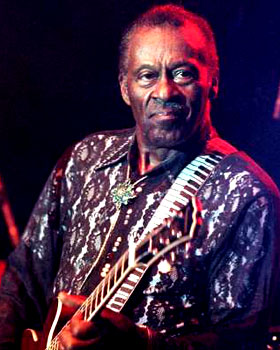
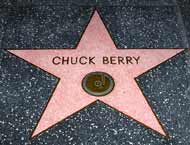
Chuck Berry was one of the fathers of rock 'n' roll music. An innovative guitarist and sly wordsmith in the 1950s, his sound and persona were a core influence on the coming British Invasion of the Beatles, Rolling Stones, Kinks and the Who. He was rock's first guitar-hero, and his excited collision of blues and country created a new sound that can still be heard in the songs of such disparate artists as Bruce Springsteen, X and Kings of Leon.
Berry was born into a middle-class family and was drawn to the guitar early on, making his live performance debut while still in high school. On a trip to Chicago, he met bluesman Muddy Waters, who brought him in to see the owners of Chess Records. The blues label quickly signed up Berry and released his first top-10 hit, “Maybellene,” in 1955, followed by a long list of songs that are now rock standards: “Roll Over Beethoven,” “Johnny B. Goode,” “Carol” and “Brown Eyed Handsome Man.”
Like his contemporaries Little Richard and Jerry Lee Lewis, Berry was among the first true showmen of rock, ushering in a new American sound while duckwalking across stages. He also was among the first round of inductees into the Rock and Roll Hall of Fame in 1986. He was feted at an all-star celebration of his 60th birthday led by the Stones' guitarist Keith Richards, with appearances by Eric Clapton, Linda Ronstadt, Robert Cray and pianist Johnnie Johnson, a key collaborator in Berry's first decades. The concert was shown in the acclaimed 1987 documentary “Hail! Hail! Rock 'n' Roll,” directed by Taylor Hackford (“Ray,” “An Officer and a Gentleman”).
Berry's many film appearances include “Rock Rock Rock” (1956), “Go, Johnny, Go!” (1959) and “American Hot Wax” (1979). He also appeared in the 1964 influential concert film, “The T.A.M.I. Show,” filmed at the Santa Monica Civic Auditorium.
In his youth, Berry had minor brushes with the law, but was sentenced to two years in an Indiana federal prison at the height of his career over a 1959 Mann Act violation — after transporting a teenage girl from Texas to work in his St. Louis nightclub. In 1979, he spent 100 days in prison for tax evasion.
He enjoyed an unlikely comeback hit in 1972 with “My Ding-a-Ling,” a playful singalong of harmless sexual innuendo. It went to No. 1. And later the same decade, NASA launched the Voyager Space Probe into deep space with a disc of recordings from earth, including Berry's “Johnny B. Goode,” right alongside music by Beethoven and Stravinsky — a motorvatin' lesson in music appreciation for any aliens who stumble across it.
Berry died Mar. 18, 2017 at his home near St. Louis, Mo. He was 90.
Related stars
|
|
One thought about Chuck Berry
Share a thought about Chuck Berry