Fibber McGee & Molly
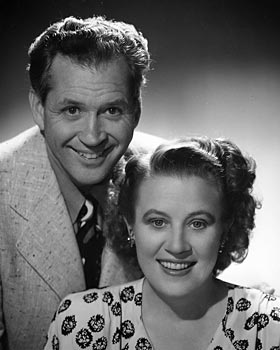

As "Fibber McGee and Molly," Jim and Marian Jordan moved from struggling vaudevillians to $3,500-a-week radio entertainers, consistently topped Bob Hope and Jack Benny in the weekly ratings, amused a nation beset by Depression and war, and every Tuesday night endured the world's most famous cluttered closet.
The Jordans were childhood sweethearts in Peoria, Ill. He was the son of a farmer who aspired to be a singer, and she was a coal miner's daughter who wanted to teach music. They combined their lives and talents in 1918, the year they married, formed a vaudeville act and went on the road at $35 a week.
They tried a brief stint at Peoria radio station WIBO, but the job couldn't support them and their two children. Back to vaudeville they went, but by 1927 radio called again, this time station WENR in Chicago.
They went on the air there as "The Air Scouts," according to the radio anthology "Tune in Yesterday," and it was on that show that Marian Jordan perfected the little-girl voice that was to bedevil Fibber nationally several years later. Probably the single most important event in their career came in 1931, when they teamed with writer Don Quinn in a show he created for them called "Smackout."
Jim Jordan played a grocer who bragged that he stocked all manner of necessities in his store but when asked for an item would search for a moment and then admit, "Guess I'm smack out of that." What he never lacked, however, was an endless supply of tall tales. The show ran for four years in Chicago before an advertising executive for Johnson's Wax heard it and put it on the air coast to coast on the old Blue (NBC) Network.
In April 1935 they launched a new show, with Jim Jordan as an unemployed small-town Midwesterner named Fibber McGee, and Marian as Molly, his ever-patient wife, who would retort to his bad jokes, "T'ain't funny, McGee!"
According to the Radio Hall of Fame, which inducted the duo in 1989, the program struggled in the ratings until 1940, when it became a national sensation. Within three years, it was the top-rated program in America.
The couple lived at 79 Wistful Vista (Sad Street) and welcomed to their door such unforgettable characters as Throckmorton P. Gildersleeve, Wallace Wimple (wed to "Sweety-Face, my big fat wife"); the Old Timer ("that's purty good, Johnny, but that ain't the way I heared it"); Beulah the black maid ("somebody bawl for Beulah" and "love that man") — played by Marlin Hurt, a white man; and Myrt, Fibber's omnipresent telephone operator ("how's every little thing, Myrt?"). Listeners never heard Myrt's end of the conversation, only Fibber's reactions, such as this exchange: "What's that Myrt, your uncle smashed his face and broke one of his hands?" Molly, overhearing, would say, "The poor man. Did he fall down the stairs?" "Nope," Fibber would respond. "Just dropped his watch."
And then there was the closet.
"We were always looking for a running dingus, a gag," Jim Jordan said. "We tried all kinds of things to keep a gag going but nothing worked. Then a writer did a show about how Fibber was slovenly and when he opened a hall closet door, everything fell out."
Each Tuesday, America gathered in front of its radio to hear this monument to sound effects men: A split second after Molly had frenetically warned, "Don't open that closet!" could be heard the first trickle of debris. Things would crash to the floor in alternating cacophonous waves and after the waves had crested would come a blessed moment's silence and then the coda—the thin ring of an obviously weary bell. It was Fibber's cue to remark, "Gotta straighten out that closet one of these days."
Throughout World War II, the Jordans, Quinn and a new writer, Phil Leslie, injected patriotic messages into their comedic routines: Fibber paying premium prices for black market meat in a time of meat rationing only to find the meat spoiled; episodes illustrating the need for gas and rubber rationing. But when the war ended, it wasn't only gasoline and tires that became abundant. Peace produced television sets, and life on Wistful Vista was never again to be as full.
Marian Jordan died April 7, 1961. Jim Jordan died April 1, 1988.
Burt A. Folkart in the Los Angeles Times
Related stars
|
|
One thought about Fibber McGee & Molly
Share a thought about Fibber McGee & Molly