Red Skelton
Stars
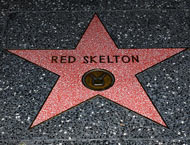
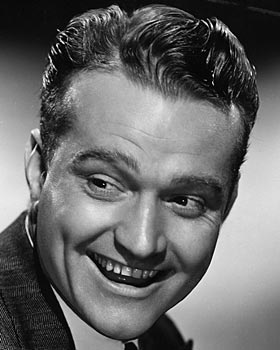
Red Skelton was the rubber-faced harlequin and pantomimist whose antics delighted stage, radio, film and television audiences with such characters as Clem Kadiddlehopper, Freddie the Freeloader and the Mean Widdle Kid.
His career spanned six decades, encompassed all media, made him a multimillionaire and a star in every form of entertainment from burlesque to television to the art gallery.
He went to work when he was 7 years old, selling newspapers on the street. At the age of 10, he got his first taste of professional show business when a snake oil purveyor named Doc Lewis hired him as an assistant — to do nothing more glamorous than fall off the stage.
Skelton got his first screen test in 1932, but he was given a dramatic script and it was a failure. Some two-reel comedies produced by Vitaphone in New York and occasional forays into waning vaudeville were also discouraging. Skelton began to toy with the idea of "getting out of the business and into business," when his luck changed in Canada.
After a month or two at the Lido Club in Montreal, Skelton moved to the Princess Theater in Montreal as master of ceremonies — also a smash — and on to Toronto, where he packed in audiences for nearly a year.
It was at this point that Skelton began some of the routines that would make him famous. Doughnut Dunking — a comedic exploration of every known method — became his first successful "silent spot" or pantomime, while bits and pieces of such routines as "Guzzler's Gin" and "Clem Kadiddlehopper" began to crop up in monologue from time to time.
His success at Loew's State, in New York, had two immediate consequences: an invitation to make his radio debut with a guest spot on Rudy Vallee's show on Aug. 12, 1937, and a booking in Washington that gained him an invitation to the White House.
Vallee invited him back two weeks later, and President Franklin D. Roosevelt was so taken with him that his appearances at the president's birthday ball became an annual affair.
In 1940, he appeared for six weeks in New York with a vaudeville act that now included Lupe Velez, and returned to the screen for a minor role in "Flight Command" with Robert Taylor and Walter Pidgeon, followed by another comedic appearance (teamed with "Rags" Ragland) as a hospital orderly in "The People vs. Dr. Kildare."
His big breakthrough in movies, however, came in 1941 with the release of "Whistling in the Dark," in which he starred as a radio performer trying to solve a murder mystery.
He followed with similar roles in two more movies — "Whistling in Dixie" and "Whistling in Brooklyn" — while establishing himself among radio's dozen leading comics with the weekly show "Red Skelton's Scrapbook of Satire."
The radio shows became a fixture in network programming, while his film credentials were bolstered by such successes as "Lady Be Good," "Maisie Gets Her Man," "Panama Hattie" "Ship Ahoy," "Dubarry Was a Lady," "As Thousands Cheer," "Bathing Beauty" and "I Dood It," which took its title from a phrase he had coined in connection with the Mean Widdle Kid character in radio.
Other radio characters — many of which were translated to television a decade later — included San Fernando Red, Willie Lump Lump, Cauliflower McPugg, Freddie the Freeloader and Deadeye.
Unhappy with his films after the war, he found new satisfaction in television. "The Red Skelton Show" first appeared on network TV in 1951; it was an immediate hit, maintaining that status until its final season two decades later.
Reflecting on his life in a 1979 interview, Skelton pronounced himself "lucky."
"I'd have avoided some of the pain if I could. Anyone would," he said. "But I wouldn't have missed knowing any of the people — even the ones whose leaving hurt most. In fact, the only thing I'm sorry about is that I didn't meet one particular guy, a clown named Joe Skelton."
Related stars
|
|
Five thoughts about Red Skelton
Share a thought about Red Skelton