Ronald Colman
Stars
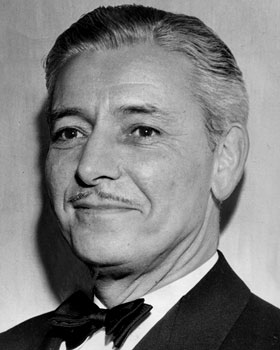
Ronald Colman was a veteran British-born actor who was among the top film stars for three decades.
Curiously, the picture for which he won the Academy Award as the best actor of 1947, "A Double Life," was not a big box-office hit. He also was nominated for an Oscar for 1929/30's "Bulldog Drummond" and "Condemned" and 1942's "Random Harvest."
Although recognized as one of the all-time great actors in filmdom, Colman probably was best known for his debonair manner and halting British speech, which became a trademark imitated by nearly all impressionists.
His first part was in a dramatic sketch that toured England as a feature of the "varieties," equivalent of American vaudeville.
Feeling that America offered better opportunities, Colman landed in New York in 1920 with $57 in cash, three clean collars, two letters of introduction — and his British accent.
He made his American stage debut with three walk-on parts in "The Dauntless Three," starring Robert Warwick. Two years of extra work and small parts followed, including a seven-month tour with Fay Bainter in "East Is West."
His big break came when he got an important supporting role in the Shubert production of "La Tendresse," starring Ruth Chatterton and Henry Miller. Screen director Henry King saw Colman and signed him for the leading male role opposite Lillian Gish in the film "The White Sister."
The pictures rolled out — "Ramola," "The Dark Angel," "Kiki," "The Magic Flame," "The Night of Love," "Leatherface" and "The Rescue."
He was an immediate hit and a star from then on. He became a Hollywood's romantic hero, stepping into the shoes of Rudolph Valentino and John Gilbert.
He slipped through the sound barrier when he created Bulldog Drummond, a cinema character that became one of the greatest drawing cards of its time. The pictures kept coming—"Devil May Care," "Raffles," If I Were King," "The Talk of the Town" and "Kismet."
After his award-winning performance in "A Double Life," Colman played only one full-length role, in "Champagne for Caesar." He then appeared in the episodic "Story of Mankind" and he had a brief scene in "Around the World in 80 Days" as a train conductor in India.
Related stars
|
|
Points of interest
Academy Awards
| Year | Category | Work | |
|---|---|---|---|
| 1929 | Best Actor | Bulldog Drummond | Nomination |
| 1929 | Best Actor | Condemned | Nomination |
| 1942 | Best Actor | Random Harvest | Nomination |
| 1947 | Best Actor | A Double Life | Win |
Six thoughts about Ronald Colman
Share a thought about Ronald Colman